Differences in Investment in Automation, Data Digitalization, and Quality Assurance Research between Japanese and Chinese Companies
The differences in investment strategies between Japanese and Chinese enterprises reflect different socio-economic contexts, labor market structures, and stages of industrial development.
1. Investment in Automation
Japanese Companies:
The main context is an aging population and high labor costs, combined with a mature supporting industrial ecosystem.
-
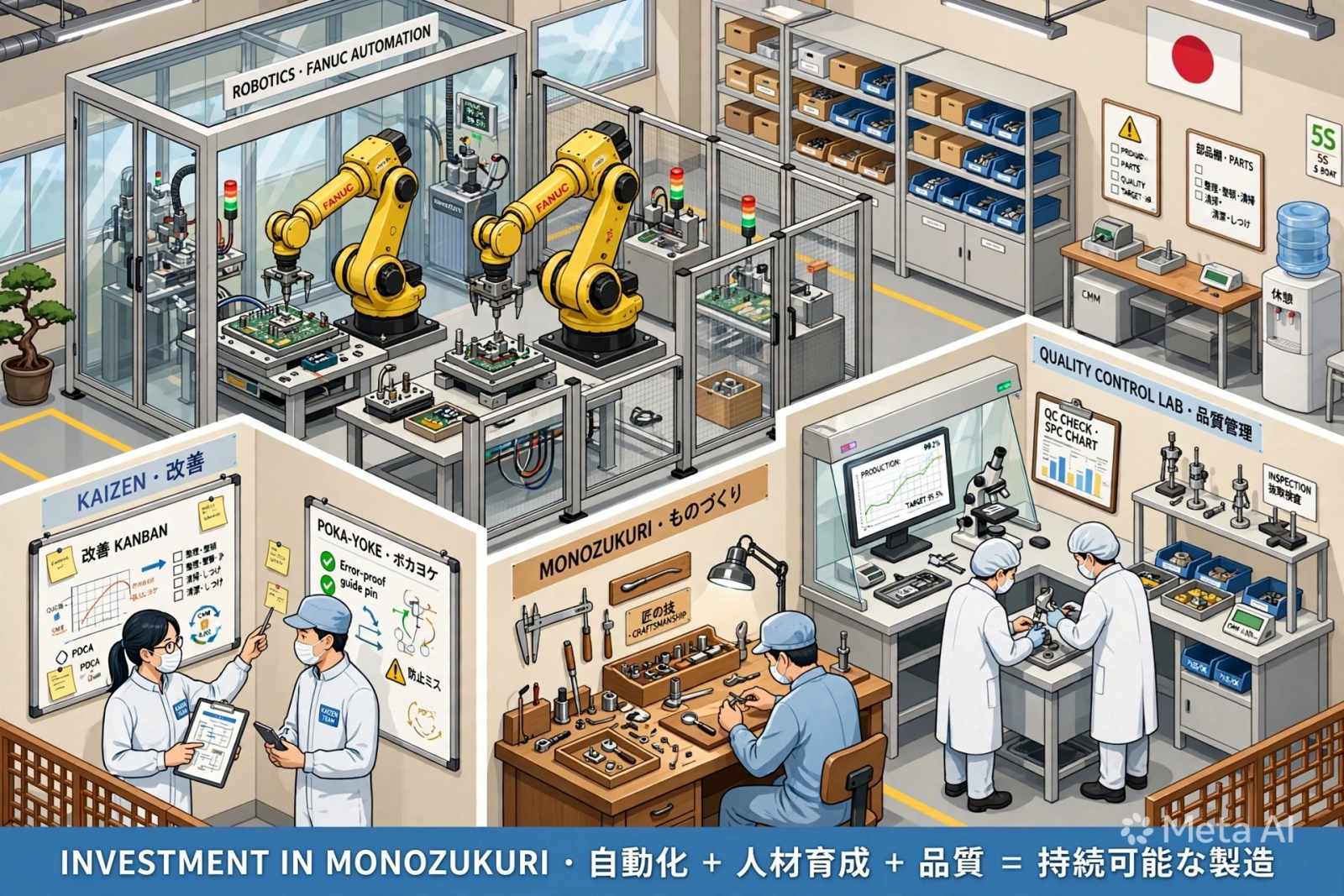
Approach: Focus on highly reliable automation with the ability to automatically stop when an abnormality is detected, commonly referred to as Jidoka.
- Investment Characteristics: High initial capital investment per production line, prioritizing high-precision robots and equipment for processes requiring small tolerances. The robot density per 10,000 employees is among the highest in the world.
- Measurable Objectives: Long-term production stability, maintaining product consistency, and reducing dependence on manual labor in repetitive processes.
Chinese Companies:
The main context is a large domestic market scale, fast growth rate, and demand for capacity expansion.
- Approach: Focus on large-scale automation to increase output quickly.
- Investment Characteristics: It is the world's largest market for consumption and installation of industrial robots, accounting for more than 50% of new robot installations globally each year according to IFR reports. Enterprises use a combination of imported and domestically produced robots to accelerate automation coverage.
- Measurable Objectives: Shortening time-to-market, increasing output per unit of time, and optimizing costs at large scale.
2. Investment in Data Digitalization
Japanese Companies:
-
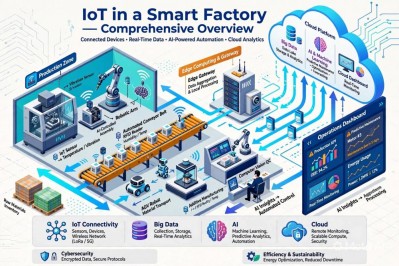
Approach: Digitalization from the equipment layer upward. Data from PLCs and sensors is collected in detail to support continuous improvement (Kaizen).
- Investment Characteristics: Prioritizes stability, accuracy, and data security. The adoption rate of Edge Computing - processing data directly at the machine - is relatively high to reduce latency and disruption risk. The migration to public Cloud platforms is more cautious due to security requirements.
- Measurable Objectives: Reducing process variation, tracing root causes of defects, and maintaining stable operations.
Chinese Companies:
- Approach: Digitalization from the platform layer downward. Building a centralized IIoT platform to connect multiple factories.
- Investment Characteristics: Heavy investment in industrial Cloud platforms, Digital Twin, and AI applications for production scheduling, warehouse management, and forecasting. Driven by national-level policies such as "Made in China 2025" and a developed industrial internet ecosystem.
- Measurable Objectives: Ability to connect supply chains on a large scale, speed of deploying new applications, and centralized data analytics capability.
3. Investment in Quality Assurance Research
Japanese Companies:
-
Approach: Quality is integrated into the process from the design stage, often described by the concept of Monozukuri.
- Investment Characteristics: Significant resources allocated to personnel training, error-proofing mechanism design (Poka-Yoke), and research on materials and durability. The quality management system focuses on preventing errors from occurring.
- Measurable Results: Defect rates are often controlled at the PPM (parts per million) level, while new product development time is typically longer.
Chinese Companies:
- Approach: Quality is ensured through standardization and automated inspection at the final stage, combined with a rapid product improvement loop.
- Investment Characteristics: Large resources allocated to Automated Optical Inspection (AOI) systems, AI-based computer vision, and laboratories with international certifications such as ISO, CE, and UL to meet export requirements.
- Measurable Results: Fast launch of new improved versions, with quality in industries such as consumer electronics and electric vehicles having met common international standards.
Neutral Summary:
|
Pillar |
Japanese Model |
Chinese Model |
|---|---|---|
|
Automation |
Prioritizes depth and precision |
Prioritizes breadth and expansion speed |
|
Digitalization |
Bottom-up, focused on stability |
Top-down, focused on connectivity |
|
Quality Assurance |
Focused on prevention from design |
Focused on detection and rapid improvement |
Both models are rational responses to their respective conditions. The current trend shows convergence: Japanese companies are accelerating investment in Cloud and AI, while Chinese companies are increasing investment in process standardization and training to improve long-term stability.